The school leaders I've talked to run their school out of nine browser tabs, four spreadsheets, a student information system that doesn't talk to the enrollment system, and an inbox. The picture of how the school is actually doing lives in their head, assembled fresh every morning from all of those places. That assembly is the tedious part of the job, and it's the part that eats the time that was supposed to go to teachers.
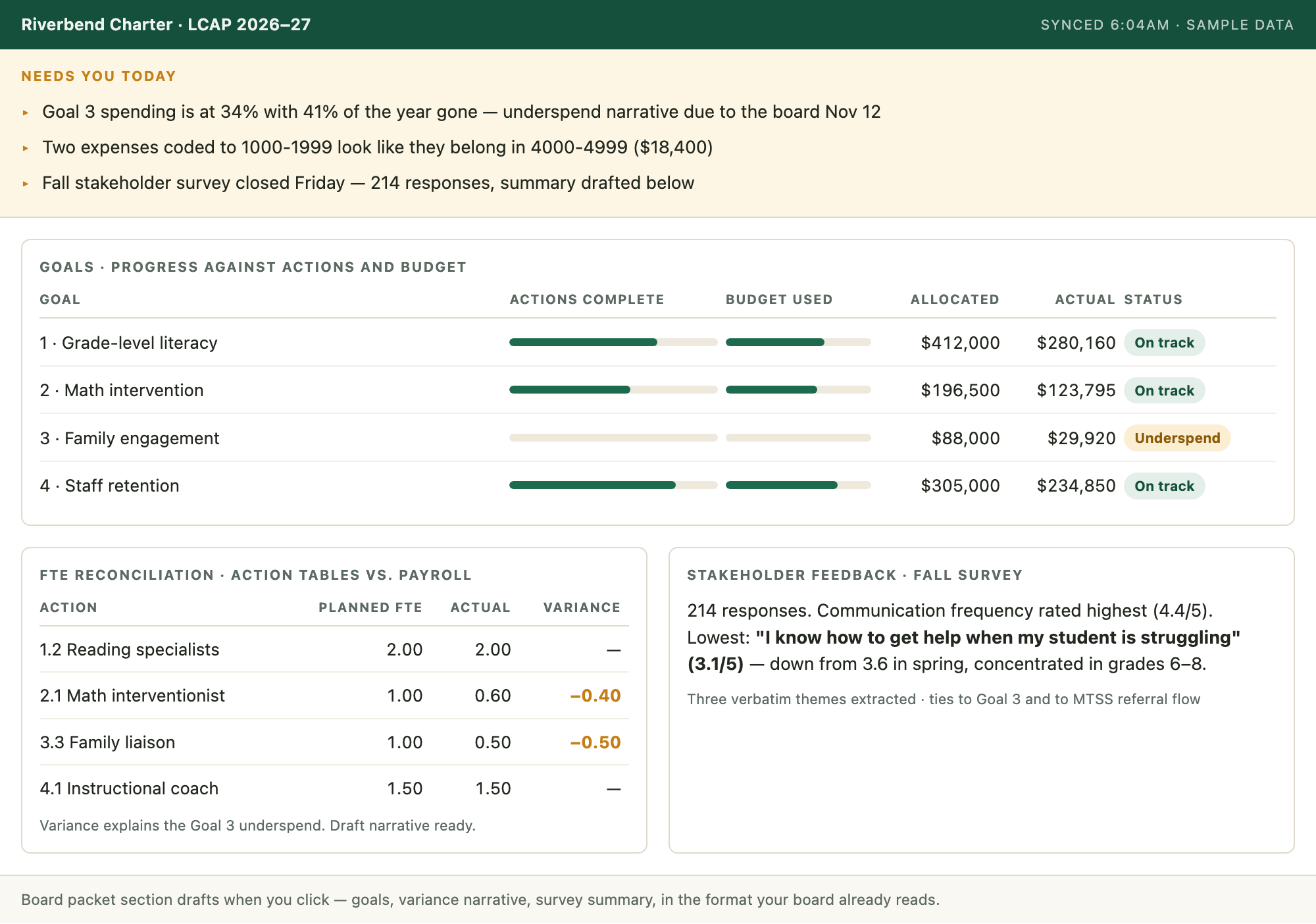
An AI command center is the place where that picture lives instead. One screen that shows what needs your attention, where your energy can go to move the school's goals forward, and how the vision you set in August is actually going in October.
The point of it is not the screen. The point is that you spend less time clicking around on your computer and more time with humans... doing the part of the work that feels creative, that fills you up, that feels connected to your students and your coworkers.
What it is not
It is not a robot that does your job for you. It doesn't know better than you do. You teach it what matters, and then it helps you stay on top of it. It doesn't replace critical thinking. It puts the facts in one place so the thinking is easier to do.
Clarity first
Everyone expects the first benefit to be hours. It usually isn't. The first thing a command center gives a leadership team is clarity... everyone looking at the same numbers, arguing about the same thing, understanding what the numbers mean. Driving clarity and alignment toward a vision helps school leaders tell a story, and align people toward it. The hours come after that, once the team stops rebuilding the picture in every meeting.
One example
Here's one administrator who built a dashboard. Karsten Stampa, chief of staff at Bullis Charter School, calls his a School Health Dashboard: student attendance, staff attendance, discipline, and test results on one screen for his leadership team, by grade level.
When I asked how it was making things better, he didn't say time. He said: "We are all talking and we are all seeing the same thing... when we look at it presented nicely, we also have a good understanding of the data itself."
Building it forced his team to get clear on things they'd been living with as inconsistencies. That's the pattern. The dashboard is the receipt. The clarity is the product!
What a leader needs on day one
Not a budget line. Not an IT ticket. What a leader needs on day one is more presence in their job... feeling grounded, feeling like they have the time and energy to be the leader they want to be, to inspire the teachers, and help them inspire their students. A command center is worth building only if it gives you that back.
What it should never touch
A command center should never touch the amount of individual attention a teacher can give a student. It should only enhance that. It shouldn't automate those things.
It should streamline the rest. The compliance report. The attendance roll-up. The picture that used to live in your head. So administrators spend more time with teachers, and teachers spend more time with students.
How to start
Try this as an exercise. It takes ten minutes, and the first version will be rough... that's the point! Run it again next week with better answers, and the picture gets clearer each time.
I lead a school. Before you build anything, ask me a few questions: what I check every week to know how the school is doing, where that information lives today, and what I'd want on one screen. Then build me a simple first version of a command center from my answers, and tell me plainly what it can't see yet.