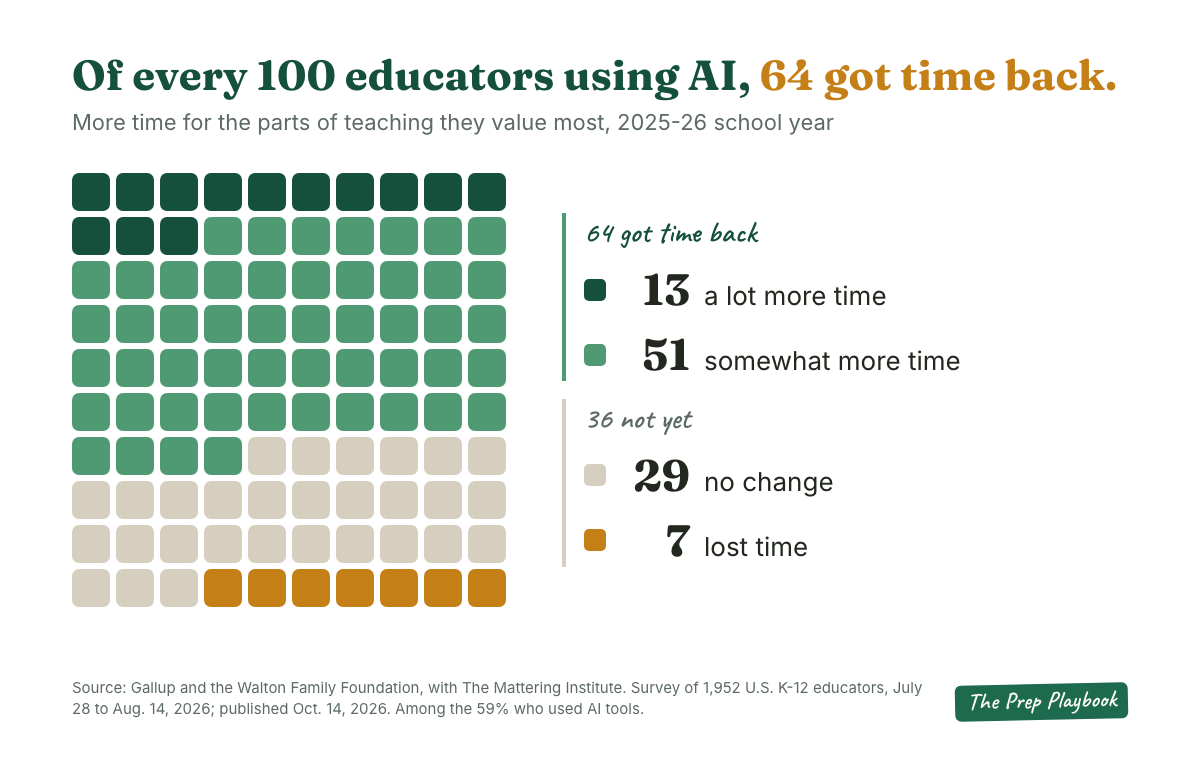
For most who use it, yes. In a Gallup survey of 1,952 K-12 educators, done with The Mattering Institute and published October 14, 2026, 64% of those who used AI said it gave them more time for the parts of teaching they value most. And the time comes from the work that matters least to them: administrative tasks.
- 59% of K-12 educators used AI tools in the 2025-26 school year.
- 64% of them got more time for what they value most.
- 85% say helping a student through something difficult makes them feel they matter. Admin work ranks last!
- 36% of AI users haven't gained time yet: 29% saw no change, 7% lost time.
What work makes teachers feel they matter?
Gallup asked. The top answers are all about students: helping a student through something difficult (85% say it makes them feel they matter a great deal), seeing students do well (74%), giving students individual feedback (57%), leading creative, hands-on activities (50%).
And at the other end: "administrative tasks are by far the least likely to give educators a strong sense that they matter."
What should AI take off a teacher's plate?
Reading this study felt so timely! It's straight up validation for a matrix I developed in my AI training work, and that Annie and I now use with teachers and administrators. This exercise often helps people think through where to start: the easy quadrant of things they hate to do that AI can handle well, and then shifting that time toward the things AI isn't good at and that feel more meaningful.
Picture a school week on two lines. Across the top: is AI good at this work, or not good at it yet? Down the side: is this work you love, or work you don't like? That gives four corners... and a simple approach for what to start handing off, and what to keep and support more of.
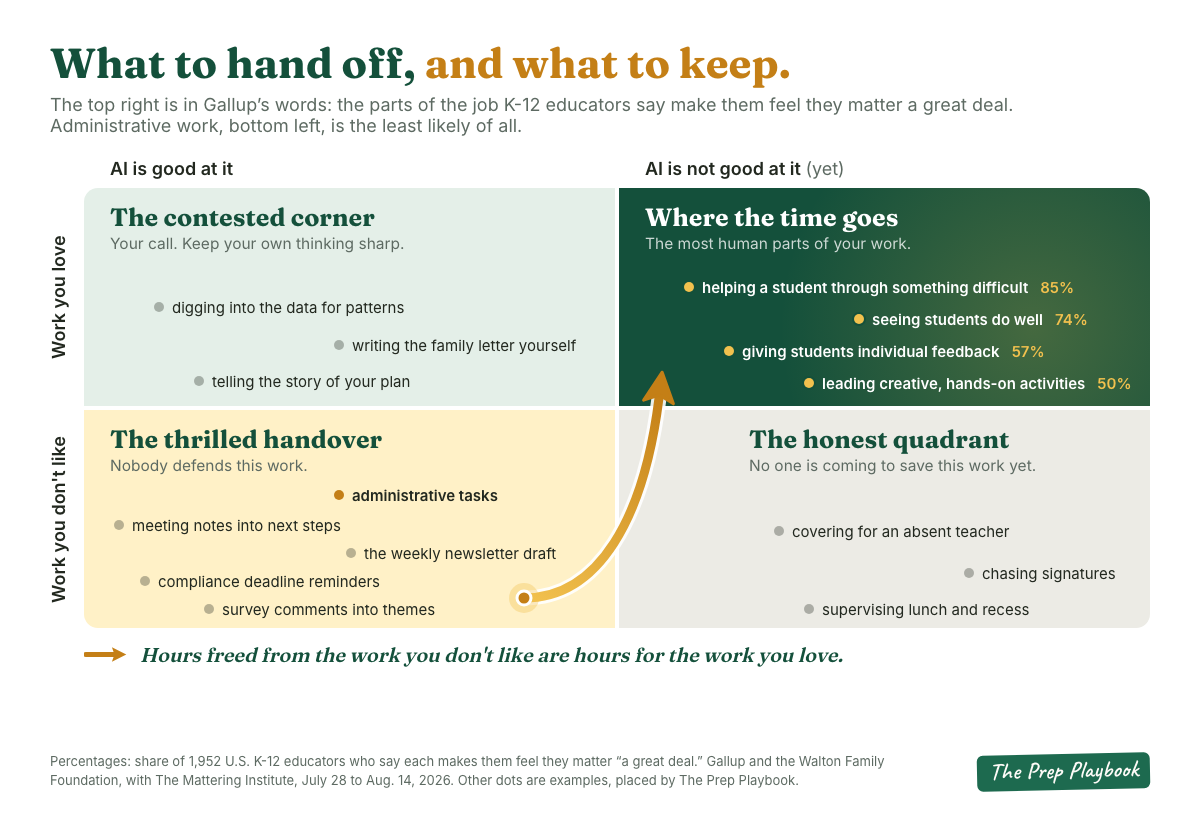
The thrilled handover (bottom left) is work AI is good at that nobody defends: turning meeting notes into next steps, compliance reminders, a first draft of the newsletter, sorting survey comments into themes. It's the easy quadrant... and the best place to start, because nobody fights to keep it.
Where the time goes (top right) is the most human, meaningful part of the job, the work Gallup just measured. AI isn't good at it. You are!
The other two corners matter less here: the contested corner is work some people love doing themselves (their call), and the honest quadrant is work nobody loves that AI can't take yet.
The point of the matrix is the arrow! When AI takes on the bottom left, it can free people up from the left side... and those hours go up and to the right.
How much time does AI save teachers?
Gallup didn't measure hours, so don't quote hours from this study. It measured whether AI gave educators more time for what they value most... and most of those using it said yes.
Why hasn't AI saved time for everyone?
For 29% of the educators using AI, it made no difference to their time. For 7%, it cost them time. The survey doesn't say why. I don't think it's a verdict on the tools... I think it's sometimes an initial learning curve to invest in, and then it pays off. Good trainings and good tools make that learning curve much smaller and more accessible. Most people meet AI alone, on a Tuesday night, with no one beside them and no map of which corner to start in.
Are teachers good at using AI?
We find that educators are uniquely good at this! It almost always comes easier to them than they think... they're naturals. Teachers are very good at teaching how to do a skill or accomplish a task, and they're very good at explaining things. That's the skill of learning to use AI well. So the gap isn't talent... it's time, a starting point, and just some plain empathetic human encouragement.
Where should a school start?
With the bottom left! That's what the Running Start is for: about a month, one hands-on session where your team maps its own week onto the matrix and builds something for the bottom left, and help in between. The top right stays yours.
Source: Gallup and the Walton Family Foundation, with The Mattering Institute, "Teachers Using AI Say It Frees Up Time for What Matters Most," October 14, 2026. Survey of 1,952 U.S. K-12 educators (teachers, paraprofessionals and other classroom staff), July 28 to Aug. 14, 2026.
Related: Can school administrators get Claude for Teachers free?